Broomfield's E-Ordinance Update
For context: I write this as a class 1, 3 e-bike rider, regular bike rider, motorcycle rider, walker, runner, driver, and dog walker.
UPDATE: Council has postponed consideration of an ordinance addressing off-Highway electric scooters, e-bikes, and other low-powered e-vehicles and devices. It will NOT be on tonight's agenda (Aug 25).
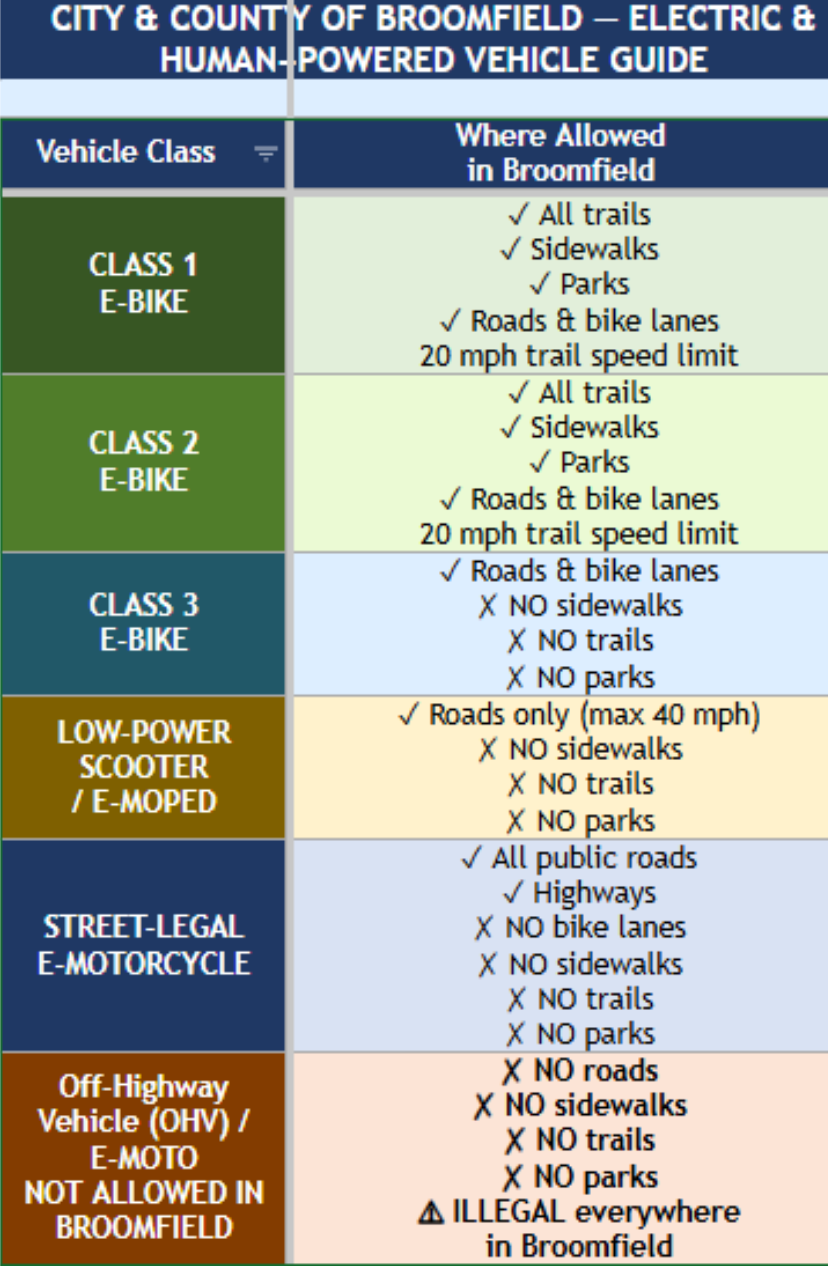
Nobody walks into a council meeting excited to talk about municipal code. Fair enough. BMC 10-16 dates back to 1978, an era when the wildest thing on a bike path was a kid on a banana-seat bike, showing off. Nobody writing that code could have pictured a Class 3 electric bike hitting 28 mph on a sidewalk next to a stroller. That’s not a failure of imagination. It’s just what happens when the technology outruns the paperwork by about five decades.
What This Ordinance Actually Does
Ordinance No. 2311 updates that old code and also amends the Model Traffic Code’s Careless Driving provision (MTC 1402) so it explicitly covers pedestrians, trail users, bike and pedestrian paths, unpaved surfaces, and open lands not meant for wheeled travel. The core language, Section 10-16-020(A), makes it unlawful to operate a Class 3 e-bike, low-power scooter (e-moped), or motorcycle (e-moto or otherwise) anywhere that isn’t a public roadway or that’s posted off-limits by sign. Off-highway vehicles (like e-motos) and toy vehicles stay banned from all public roadways, trails, parks, fields, and recreational areas, same as always, with the usual exception for private property with the owner’s blessing. Penalties don’t change. This isn’t about new fines. It’s about giving officers something they can actually cite when a problem shows up.
What This Ordinance Does Not Do
This is the part people talk past most often: Broomfield is not inventing a new ban on Class 3 e-bikes out of thin air. State law already barred them from bike and pedestrian paths back in 2017, and Broomfield has kept them off trails for years under its own Ride Guide. Up to now, though, an officer responding to a complaint had “website guidance” and half a state statute to lean on, neither of which amounted to an actual citable offense. This ordinance just puts that longstanding practice into real, enforceable code.
The State Framework, For Context
Colorado Revised Statutes Section 42-4-1412 sets up the three-class system used nationwide since the 2017 legislative session. Class 1 and Class 2 e-bikes, both capped at 20 mph of motor assistance, are allowed on bike and pedestrian paths by default, though a local authority can prohibit them. Class 3 e-bikes, which provide pedal assist up to 28 mph, are banned from those paths unless the path runs within a street or highway, or the local authority opts in by ordinance so if a bike lane, cycle track, or paved shoulder is built right into the street's own right-of-way, Colorado law counts it as part of the street, not a separate "path" so Class 3 e-bikes can legally use it, same as they can use the street itself. State law also hands off-highway vehicle enforcement on local public lands directly to municipalities, which is exactly why Broomfield needs its own ordinance rather than relying on the state statute alone.
Why Now
City staff point to three things converging at once: rising safety concerns for riders, pedestrians, and drivers alike, a real surge in personal motorized vehicle use across Broomfield and the wider Denver metro area, and genuine public confusion about which rules apply to which vehicle. This wasn’t drafted in a back room by one department acting alone. Open Space and Trails, Transportation, Parks and Recreation, and Communications staff all had a hand in it. That matters, because it means the ordinance responds to an actual enforcement vacuum, not a hunch.
The Math Behind the Speed Line
Here’s the part worth sitting with. The city’s Ride Guide already draws its line at 20 mph, Class 1 and Class 2 welcome on trails, sidewalks, and parks, Class 3 limited to roads and bike lanes. That boundary isn’t arbitrary. It mirrors the exact speed differential state law already uses. A shared trail or sidewalk works because most people on it move at roughly the same pace. Introduce something capable of nearly 40 percent more speed than the fastest thing already allowed there, and the severity of any collision jumps substantially, even with a responsible rider at the controls.
That also kills the “I only ride 15 mph on my Class 3 e-bike” argument as a policy justification. If someone genuinely never approaches 28 mph, they don’t need a Class 3 bike for that riding style. A Class 1 or Class 2 e-bike does the same job and stays fully legal on every trail, sidewalk, and park in Broomfield. Worth noting too: bike shops selling Class 3 bikes to people planning to ride them on trails or sidewalks should be telling customers exactly where that bike is and isn’t legal at the point of sale. A lot of this confusion starts at the cash register, not on the trail.
Sidewalks Are the Logical Next Step
Colorado already keeps Class 3 e-bikes off multi-use paths by default, and Broomfield has kept them off trails on its own for years. Sidewalks are an even tighter version of the same problem. They’re narrower than most multi-use paths, sit right up against driveways and doorways, and put an unpredictable mix of people, kids, dogs on leashes (hopefully), wheelchair users, folks with limited hearing or vision, in close range of something capable of 28 mph. Extending the existing restriction to sidewalks isn’t a new category of rule. It’s applying the same logic to the one gap left standing.
Broomfield wouldn’t be out on a limb here either. Boulder’s Open Space and Mountain Parks board banned Class 3 e-bikes from all trails and multi-use paths starting in July 2023. Centennial’s city council unanimously passed an ordinance in August 2026 barring Class 3 e-bikes and electric motorcycles from sidewalks, multi-use trails, park trails, and pedestrian paths, sending them to city streets instead. Nearly every Colorado city with a specific e-bike ordinance has landed in the same place.
Why US 36 is different from a sidewalk or multi-use path
People sometimes point to the US 36 Bikeway and ask the obvious question: if a Class 3 e-bike can ride on a bikeway beside a highway, why not on a sidewalk or multi-use path beside a street?
Because they are not the same facility, legally or functionally. The US 36 Bikeway is a regional, highway-corridor bikeway spanning multiple jurisdictions, and the corridor communities along US 36 have coordinated to treat it as a shared transportation facility rather than leaving it to each city's separate trail and sidewalk rules. It is built and managed as a commuting corridor connecting communities, not as a narrow pedestrian walkway or a local multi-use path beside homes, storefronts, driveways, and front doors.
A sidewalk and a typical multi-use path are different. State law already bans Class 3 e-bikes from ordinary bike and pedestrian paths by default, and it separately defines the roadway as the part of a highway designed for vehicles, expressly excluding the sidewalk. In other words, a sidewalk or a neighborhood multi-use path may sit beside or near a street, but neither one is a road or a bike lane. They are pedestrian and shared-use infrastructure, not a substitute for the regional bikeway exception. Colorado leaves sidewalk rules to local governments entirely, and multi-use paths are governed by the same default restriction unless a local authority specifically opts in, which is exactly why Boulder and Arvada already restrict Class 3 e-bikes from their sidewalks and local paths even while participating in the regional US 36 Bikeway arrangement.
That is not a contradiction. It's a sensible distinction. A regional, highway-adjacent bikeway is built wider, faster, and with fewer access points for longer trips and through travel, much like an interstate is for cars. A sidewalk or local multi-use path is a close-quarters space shared with people walking dogs, pushing strollers, leaving driveways, stepping out of shops, or simply trying to get home. Same city, different room, different rules.
What Happens When Cities Wait Too Long
Two states show what happens when rules stay loose until something forces a heavier hand. New Jersey’s S4834, which took effect in July 2026, scrapped the standard Class 1/2/3 system entirely. Now e-bikes need registration with the Motor Vehicle Commission, riders need an age-appropriate license, and higher-powered categories that absorb what most states call Class 2 and Class 3 need liability insurance with minimums of $15,000 per person and $30,000 per accident. Hawaii, one of only two states requiring e-bike registration at all, charges a $30 permanent registration fee under HRS Section 249-14 and, before its 2026 update, treated anything over the federal 20 mph motor-only threshold as a moped or motorcycle, license and DMV registration required.
Iowa is the opposite failure mode: overreach in the other direction. House Study Bill 637, introduced in January 2026, would have banned any “device,” bicycles, e-bikes, scooters, wheelchairs, strollers, from roads with speed limits above 25 mph, treating violations as a criminal misdemeanor with up to 30 days in jail and fines near $855. It also would have banned Class 3 e-bikes from sidewalks and multi-use trails statewide. Public backlash got it pulled, but it’s a good example of what happens when a legislature swings a blunt instrument because local governments never drew a sensible line themselves.
The Bottom Line
Broomfield’s ordinance sits squarely between those two outcomes. No licensing, no registration, no insurance mandate, and it doesn’t touch conventional bicycles or Class 1/2 e-bikes at all. It just extends an existing, well-established Class 3 restriction from trails and paths to the one place it hadn’t reached yet: sidewalks. Riders who genuinely stay under 20 mph lose nothing by choosing a Class 1 or Class 2 bike for that use. Riders who want 28 mph keep full access to every road and bike lane in town, and yes, we do need to improve those facilities. Passing this now, with no new fees and no new licensing burden, is how Broomfield and Colorado stay out of the headlines that New Jersey, Hawaii, and Iowa are currently making.